
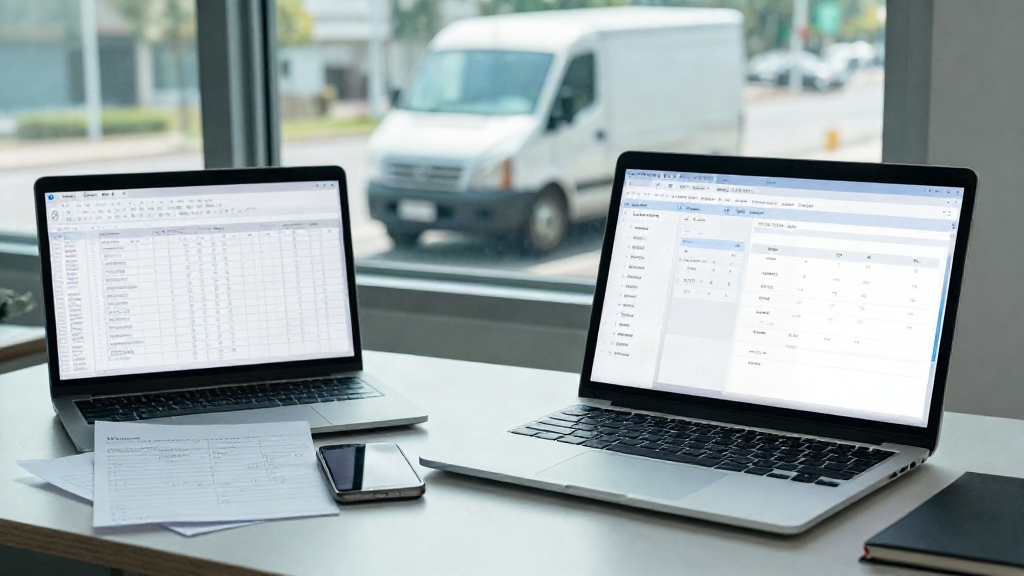
If you manage 1 to 20 trucks, the question is not "do I want software?" but "do I really need a TMS, or can I manage with Excel and WhatsApp?". It is the right question, because nobody wants to pay for a licence only to find out that spreadsheets were enough. This comparison is not intended to sell you a platform at all costs: it helps you understand where manual management works, where it starts to become expensive and at what point the move makes sense.
What Excel and WhatsApp do well
Let us start with what works, because it is not insignificant.
Excel is flexible in a way no software is: open a sheet and, in ten minutes, you have a grid of orders, customers, registration plates and addresses. You already know it, nobody needs training and the initial cost is zero. It handles the first few dozen trips a day without difficulty.
WhatsApp, meanwhile, is the fastest channel there is. You send a driver a message, a customer writes "delivery completed", and the chat becomes informal proof that the goods arrived. Everyone already has the app in their pocket, so there is nothing to install or explain.
Add phone calls: when you need an immediate reply, a call remains the quickest way to clarify an address or an unloading time.
If this is what a typical day looks like and it runs smoothly, there is no urgent problem to solve.
The hidden costs of orders spread across sheets and chats
The point is that this "runs smoothly" becomes increasingly fragile as the number of trucks and customers grows.
The first cost is time. Every order arriving by email or phone has to be copied in manually. Every delivery change has to be communicated through three channels. The driver asks for the trip sheet and you reconstruct it. Taken together, these are hours of non-billable work every week, precisely the hours in which you could be looking for new customers.
The second is human error. An address entered once in a sheet and then copied into WhatsApp is an address that can become outdated. A driver's availability updated verbally but not in the sheet is planning that falls apart. When something goes wrong, reconstructing who said what means scrolling through chats and phone calls, often after the delivery has already been missed.
The third is proof of delivery. Does the customer dispute a document? If the signature or photo is in a personal chat, you may find it when you are lucky. You do not have an archive organised by order, customer and date.
The fourth is control. How many trips did you make for a customer this week? How much did you load for a registration plate? How much did you deliver late? If answering means opening three files and a WhatsApp group, you do not have daily control: you have a feeling.
And there is a silent cost: when volumes grow, manual management does not suddenly "get worse"; it simply makes you work more for the same revenue.
When a lightweight TMS really pays off
A TMS for small fleets is not there to do more things than Excel: it is there to do them in one place, without copying them again. These are the signs that the move is beginning to pay off.
- You manage more than 5-6 trucks or more than 15-20 orders a day, and manual copying takes up half your day.
- You have more than one order-entry channel (email, phone, WhatsApp, customer portals) and need a single list.
- Every morning you plan the day in a sheet, mentally cross-checking driver availability, registration plates and addresses.
- Proofs of delivery live in scattered chats and you need to find them by order.
- You cannot answer questions such as "how many trips did customer X make this month?" in two minutes.
If you recognise yourself in two or more points, manual management is no longer free: you are paying for it in time and errors. A lightweight TMS brings orders, customers, addresses, drivers, availability and trucks into one flow, with the daily Trip Plan built once and the driver app used to close the delivery with document and signature.
How to choose without making a mistake
Not every TMS is designed for a fleet of 1 to 20 trucks. Many were created for large businesses and require months of implementation, consultants and functions you will never use. Here are the practical criteria to assess before signing.
- Start-up time. If getting started requires weeks of configuration, it is not the software for you. A lightweight TMS is activated in days, not quarters.
- Total cost, not just the subscription. Ask what is included: driver app, users, updates and support. Hidden costs are the most common way an "inexpensive" TMS becomes expensive.
- Coverage of the real flow. It must follow your day: entering the order, planning, assigning driver and truck, transport document and proof of delivery.
- Similarity to the way you already work. If you have to change your working method to use the tool, you will return to Excel within a month. The right platform resembles your process, only better organised.
- App for drivers. If a driver has to take a course to close a delivery, the system will not be used.
- Try before deciding. Look at the interface, load your real data and try a complete Trip Plan. Generic demos say nothing.
In summary
Excel and WhatsApp are not enemies: they are excellent for getting started and staying small. The problem is not the tool itself, but fragmentation when volume grows. If your day relies on manually updated sheets, chats acting as an archive and phone calls to coordinate, you are already paying the cost of manual management, only in the form of time and errors.
The right question, then, is not "TMS or Excel?" but "when does my current way of working stop paying off?". When you start having more than a few trucks and more order channels, a TMS designed for micro and small fleets gives you the organisation and daily control of Excel and WhatsApp together, without the complexity and cost of an enterprise system.
The best way to decide is to see the flow with your own eyes. Try TrucksOut with your data and compare a week of work: if it does not save you real time, you will still have the answer you were looking for.